
Knowledge base
Give the digital human your material and it answers from it. The pipeline is retrieval-augmented generation: documents are chunked, embedded, stored in Postgres with pgvector, and the best chunks are prepended to the model's context on every turn.
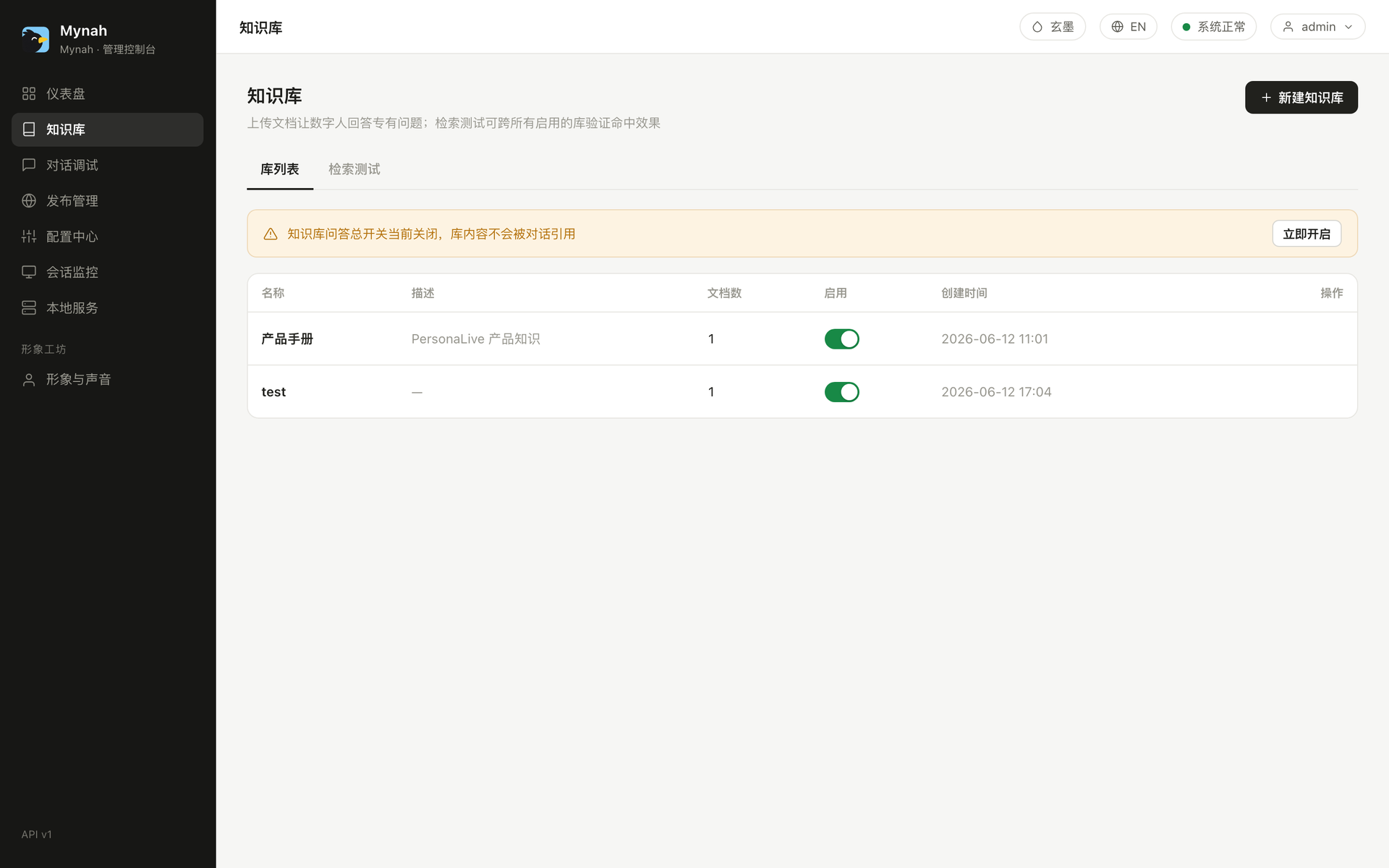
Set up
- 配置中心 → RAG: point
embed_urlat an ollama-compatible/api/embedendpoint runningbge-m3(1024 dimensions). The same ollama you may already use for the LLM works. - 知识库 → 新建知识库. The embedding model and dimension are locked into the knowledge base at creation, so later model swaps cannot silently corrupt it.
- Upload documents:
.txtand.md, up to 10 MB each. Ingestion is asynchronous:pending → processing → ready(orfailedwith the reason). Default chunking is 500 characters with 50 overlap; both are configurable. - Flip
rag.enabledon. Done; the next conversation turn retrieves.
Tune without guessing
检索测试 runs a query against the live index and shows every returned chunk with its score and the latency. Try the questions your visitors actually ask, then adjust:
| Knob | Effect |
|---|---|
top_k | how many chunks go into the prompt |
threshold | minimum cosine similarity; raise it when unrelated chunks leak in |
chunk_size / chunk_overlap | smaller chunks for FAQ-style material, larger for narrative manuals |
timeout_ms | retrieval budget per turn; past it the turn proceeds without context rather than stalling |
An optional second-stage reranker (any standard rerank API) can reorder candidates before they reach the model; set rerank_url and rerank_model.
Where it applies
Retrieval runs in the local brain pipeline (ASR → LLM → TTS). If you switch the conversation brain to Qwen realtime (speech-to-speech in the cloud) and use cloud turn detection, the cloud starts answering the moment it hears the question and there is no step where chunks can be inserted; cored logs a warning when a session is in that state. Keep turn detection local, or use the local brain, when the knowledge base matters.
Lifecycle
- Re-upload a changed document and delete the old one; or
POST /api/v1/documents/{id}/reindexafter changing chunking. - Channels do not freeze the knowledge base contents, only the RAG settings, so updating documents changes answers on live channels immediately.
- Everything lives in Postgres; back it up with
pg_dump.
What it does not do yet
Rich formats (PDF, DOCX, OCR) are not parsed by the open-source build; convert to Markdown first. A "questions visitors asked that had no good match" report is on the roadmap.